HMNZS Manawanui | 03 Bridge
Two consoles, one switch, and nobody said a word
Introduction
On 5 October 2024 HMNZS Manawanui ran onto a reef south of Upolu, Samoa, because her autopilot was engaged and nobody on the bridge knew it. The Court of Inquiry called it a series of human errors. That is accurate. It is also where most readers stop, and it leaves the more useful question untouched.
The more useful question is what the bridge was doing while the humans erred.
This post is about the physical design of that bridge: where the controls were, what they did, and what they told anyone. A separate post deals with the attention and crew-coordination side. The two are related, but they are not the same argument, and running them together is how this subject usually gets muddled.
The vocabulary, briefly
The report uses two terms in opposition: autopilot, and in hand. To take the ship in hand means to take her out of autopilot. The Court glosses it once for outsiders as switching to manual control, and the Chief of Navy used the plain version publicly when he said standard procedures should have prompted the crew to check the ship was under manual control rather than in autopilot.
There is a third term that matters: speed mode. Manawanui's autopilot was in speed mode, which means it was holding a commanded speed as well as a commanded heading. Hold on to that; it becomes the sharpest detail in the whole case.
And she had no wheel. Two aft azimuth pods, rotating to point their thrust wherever they are told, worked from levers on a console. The same physical controls serve manual steering, autopilot and dynamic positioning. What changes between those regimes is not the controls but who is holding them.
One hand reaches both
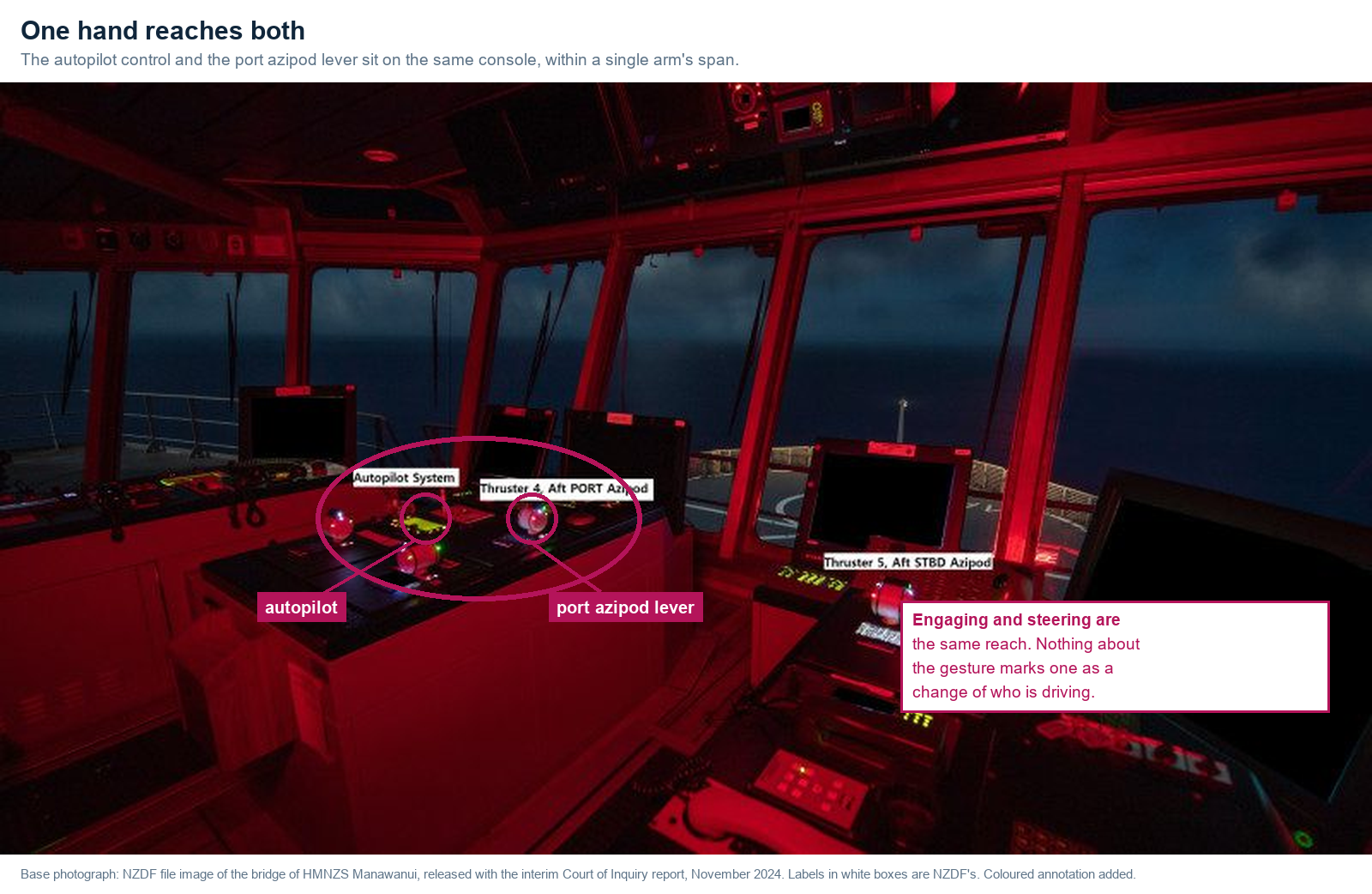
One hand reaches both. The autopilot control and the port azipod lever sit on the same console, within a single arm’s span.
File image of the bridge of HMNZS Manawanui, released by the New Zealand Defence Force with the interim Court of Inquiry report, November 2024. © New Zealand Defence Force, Crown copyright. Labels in white boxes are NZDF’s. Coloured annotation added by the author. Reproduced for commentary and criticism.
NZDF released this photograph themselves, and labelled three things on it: the Autopilot System, Thruster 4 Aft PORT Azipod, and Thruster 5 Aft STBD Azipod. The white boxes are theirs. The coloured annotation is mine.
Look at what the labelling reveals. The autopilot control and the port thruster lever are on the same console, close enough to work both without moving your feet.
So engaging the autopilot and steering by hand are the same reach, at the same desk, with much the same gesture. Nothing in the physical act distinguishes adjusting the ship from handing the ship to something else. One is a control input. The other is a transfer of authority. Your hand cannot tell the difference.
That is not a scandal. It is how a great many vessels are built. But it is the beginning of the problem, and it is worth naming before we get to the people.
The pod the autopilot was driving
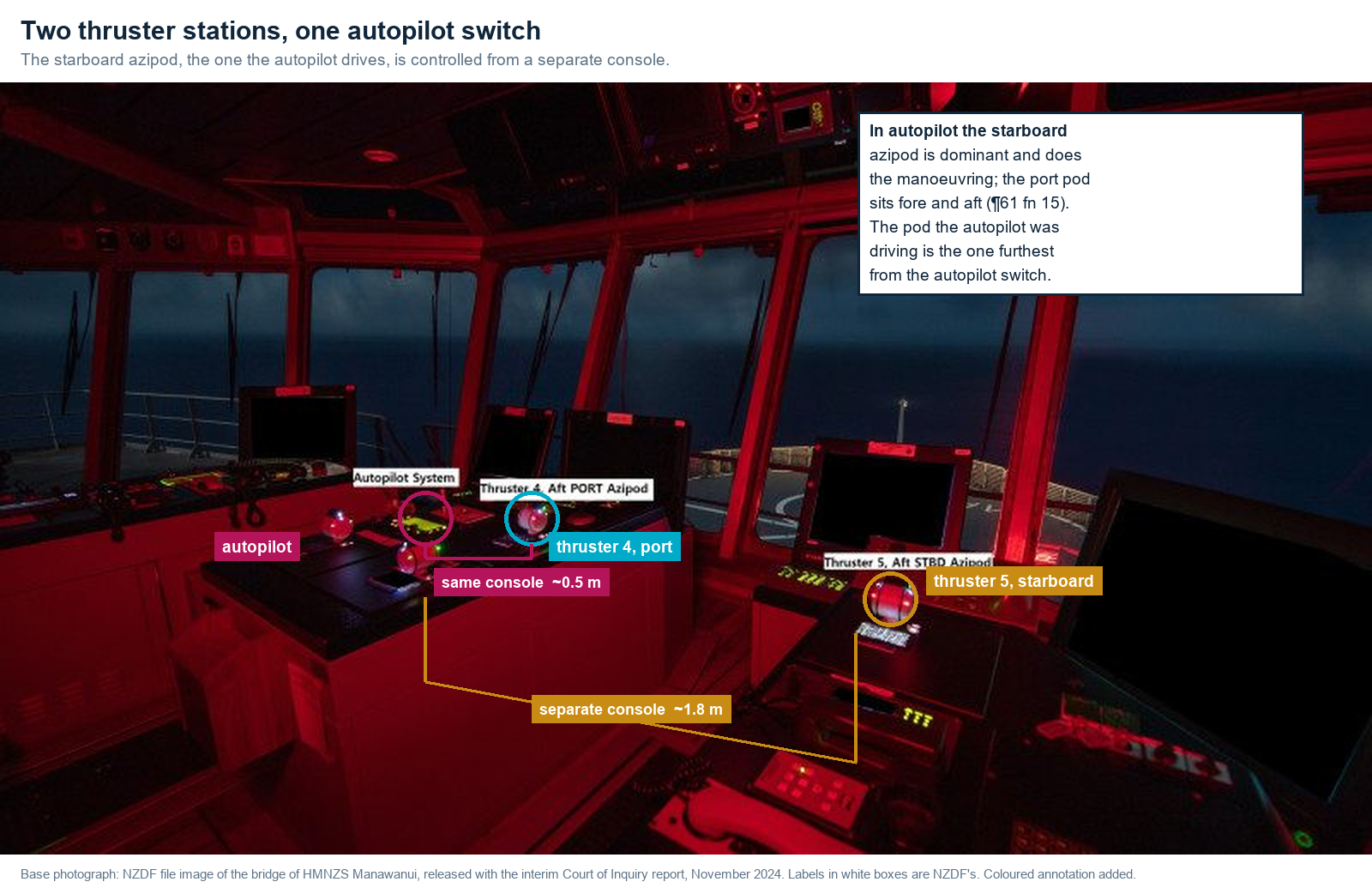
Two thruster stations, one autopilot switch. The starboard azipod, the one the autopilot drives, is controlled from a separate console.
File image of the bridge of HMNZS Manawanui, released by the New Zealand Defence Force with the interim Court of Inquiry report, November 2024. © New Zealand Defence Force, Crown copyright. Labels in white boxes are NZDF’s. Coloured annotation added by the author. Reproduced for commentary and criticism.
Here is the part I did not expect to find.
The two pods are worked from two different consoles. Port on the main manoeuvring desk, starboard from a separate pedestal across the officer of the watch’s position, roughly a metre and a half away. There is one autopilot switch, and it sits beside the port one.
Now put that against a footnote in the Court’s own report. In autopilot, the starboard azimuth is dominant and does the manoeuvring, while the port pod sits fore and aft.
Read those two facts together. The pod the autopilot was actually driving was the one furthest from the autopilot switch. A person standing at the starboard console had full authority over the thruster that was being commanded by a system whose control was not in front of them, and whose state they had no local means of changing.
I should be careful about how far that goes. The report’s layout diagram marks controls, not displays, so nobody can say from public evidence what indication existed on either console. But the geometry alone is enough to make the point: authority over the thrusters and authority over the mode were not in the same place.
Where the eyes were
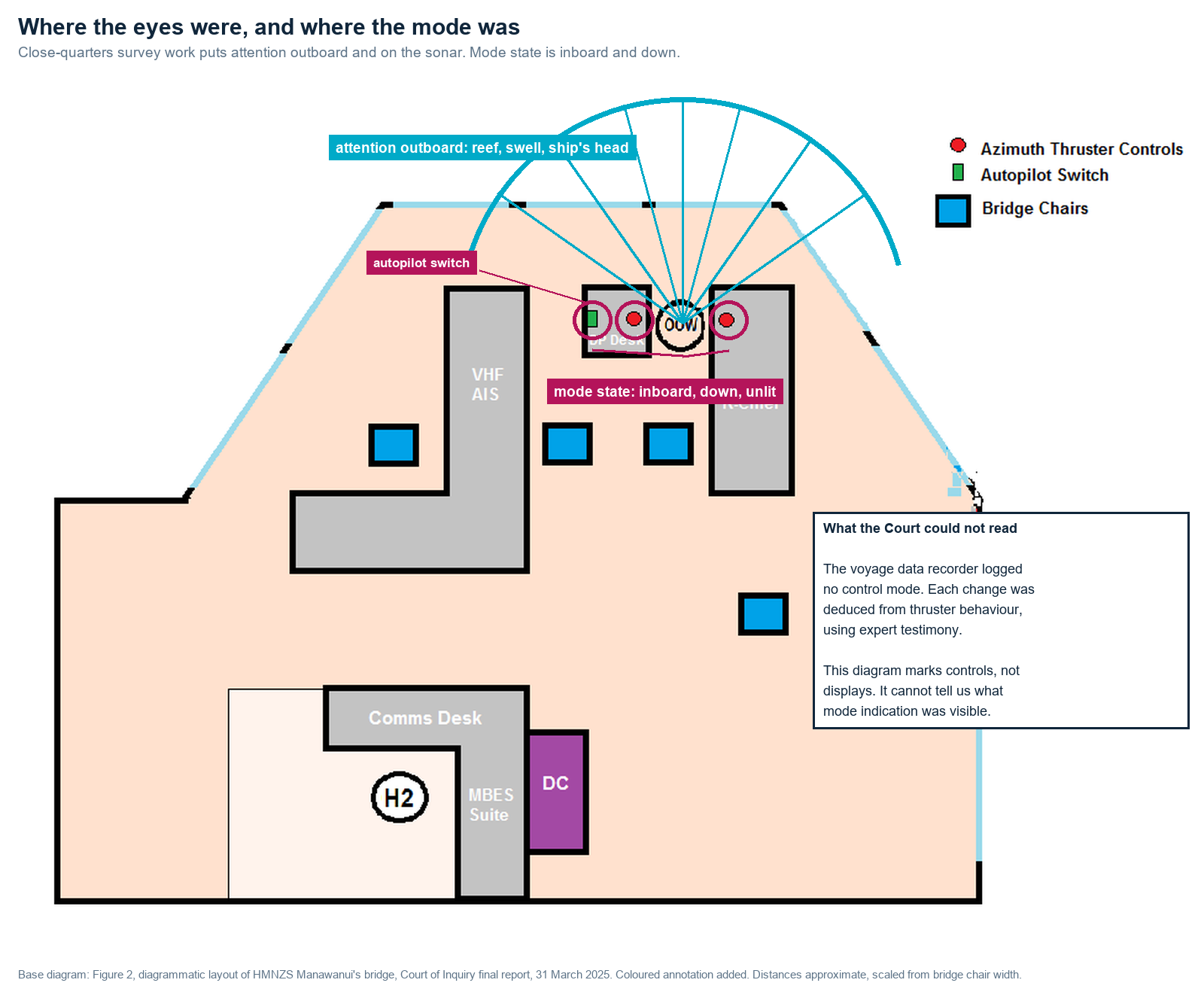
Where the eyes were, and where the mode was.
Figure 2, diagrammatic layout of the bridge, from the Court of Inquiry into the loss of HMNZS Manawanui, final report 31 March 2025. © New Zealand Defence Force, Crown copyright. Reproduced for commentary and criticism. Annotation added by the author.
She was surveying a reef, at night, in twenty-five knots of wind and a high sea state 3, about a mile off the beach. In that situation attention goes outboard — the reef, the swell, the ship’s head, the sonar returns coming in on the survey system.
Mode state goes the other way. Inboard, downward, onto a console.
There is a fact here that I think is the single most important thing in the report, and it has gone almost entirely unremarked in the coverage.
The voyage data recorder did not log control mode at all.The Court could not read the ship’s mode from the recorded evidence. It had to deduce every change from thruster behaviour — in autopilot the starboard pod dominates and the port pod sits fore and aft, whereas in hand both respond together — and it needed expert testimony to interpret that.
Sit with the implication. A formal board of inquiry, with the complete data set, unlimited time and a naval expert on hand, could only establish what mode the ship was in by inference from secondary effects.
If that is what it takes with the recorder in front of you and no reef approaching, it is worth asking what it took at a glance on the night.
The four changes nobody announced
In the nine minutes before the fatal turn, the ship changed control mode four times. In hand at 18:04:10, autopilot at 18:06:20, in hand at 18:11:13, autopilot at 18:13:08.
None of it was announced. The Court states explicitly that the 18:11:13 course alteration onto 340 degrees — the heading that put her on the reef — has no verbalisation anywhere on the recording. And its narrative captures the routine stuff faithfully, the “check port quarter” and the “start logging”, so the silence around the mode changes is conspicuous.
Two of those changes were engagements of the autopilot. Neither is attributed to anyone. The report does not say who engaged it at 18:13:08, or why, four minutes from a reef, having just hand-steered a turn towards it.
That is not incuriosity on the Court’s part. If the mode is not logged and the change is not spoken, there is nothing in the record that connects the action to a person. The passage where the Court weighs competing accounts of causation, paragraphs 83 and 84, is redacted from the public version.
So: an action with no trace, no announcement, and no author.
Full astern, and the ship goes faster
At 18:14:47 a demand was placed on both thrusters to come to starboard. The thrusters did not follow. At 18:15:57 the officer of the watch said “no steering to starboard” and the bridge settled on a thruster control failure.
At 18:16:43 the thrusters were ordered astern, with power raised to eighty per cent, then to one hundred.
And the ship accelerated.
Remember speed mode. The autopilot was holding a commanded speed. It read the astern demand as a disturbance to overcome. At 18:17:53 the officer of the watch reported ten knots increasing, under full astern. She struck the reef at about 10.7 knots.
This is the thing I would put in front of anyone who designs a control interface. The system allowed a man trying to stop his ship to drive it harder onto the rocks, and gave him no signal that this was what he was doing. Not a wrong signal. No signal.
There was no conflict alert. Nothing saying the manual input had been rejected, nothing saying the ship was in autopilot, nothing reconciling “you have demanded astern” with “the ship is accelerating”. The controls accepted every input and quietly discarded them.
Authority, oversight and training in three metres
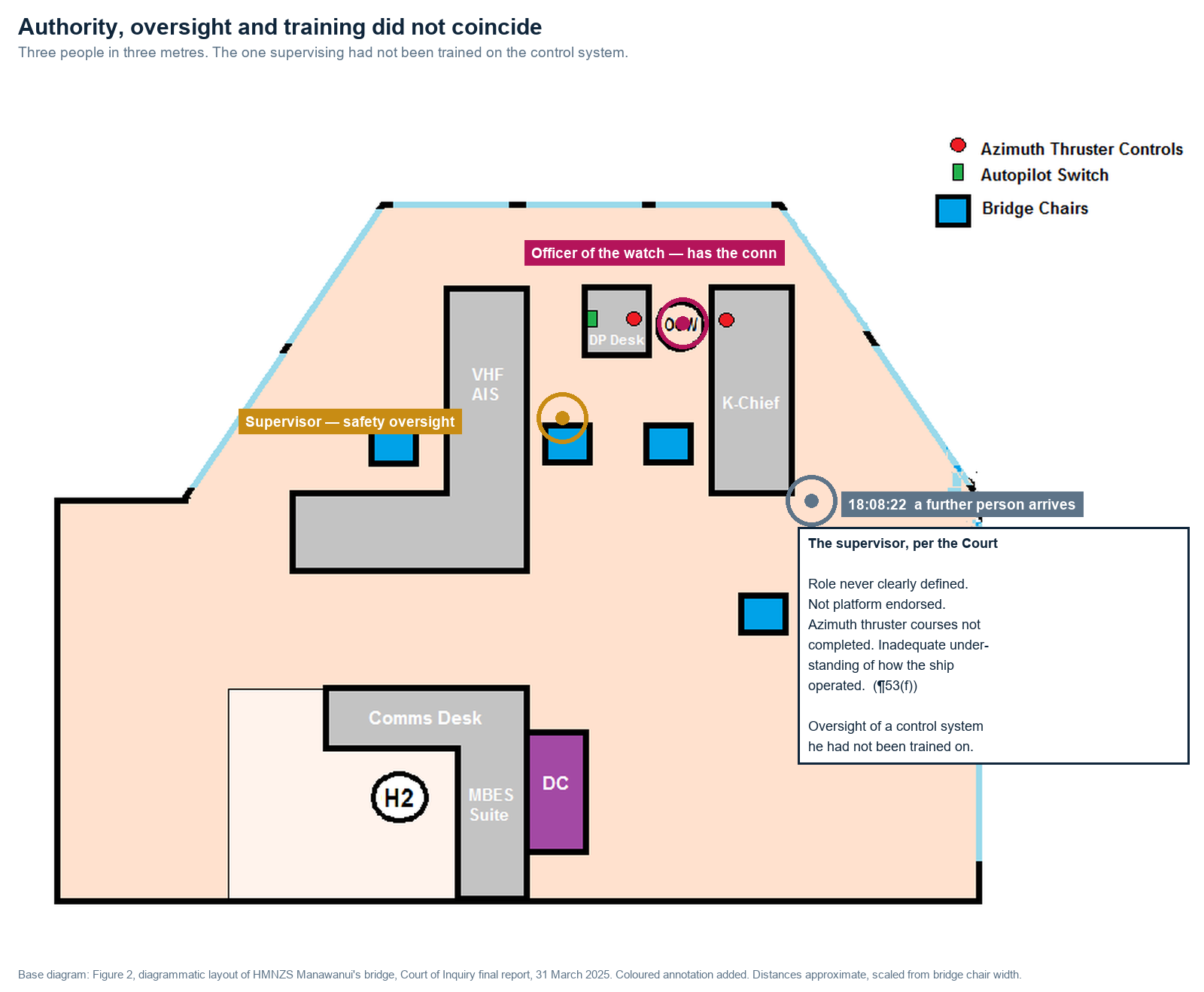
Authority, oversight and training did not coincide.
Figure 2, diagrammatic layout of the bridge, from the Court of Inquiry into the loss of HMNZS Manawanui, final report 31 March 2025. © New Zealand Defence Force, Crown copyright. Reproduced for commentary and criticism. Annotation added by the author.
Design is not only hardware. It is also where you put the people and what you have equipped them to see.
The Court found the supervisor’s role had never been clearly defined, though it was commonly understood to involve safety oversight of the survey task. It also found that the supervisor had not completed all of the azimuth thruster training courses, was not platform endorsed for the ship, and had inadequate situational awareness and understanding of how the ship operated.
Which is to say: the person positioned to catch the error was standing beside a control system he had not been trained on.
That is a bridge design question as much as a personnel one. A layout that relies on a second person to notice a mode error is only as good as that person’s understanding of the mode. Put a bridge together that way and the redundancy exists on the watch bill and nowhere else.
What would have closed it
A mode annunciator. A message reading manual input rejected. A conflict alert triggered by demanded-astern with speed-increasing. Any one of them, and 18:13:08 never becomes an error at all, because the state would have been visible without anyone needing to remember to look.
None of that is exotic. Aviation worked it out after a series of accidents in the eighties and nineties and built a whole discipline around mode awareness, to the point where “what’s it doing now?” became a stock phrase in cockpits and the answer became a design requirement rather than a pilot’s problem. The maritime world has largely not.
And here is the wider reason it matters. Manawanui was a 2003-built Norwegian offshore vessel that had worked the North Sea for sixteen years without losing herself. The bridge did not change when she became a warship. What changed was who was standing at it and what else they were carrying.
A bridge built for a specialist who switches modes all day, with a dynamic positioning ticket and little else to think about, is a reasonable bridge. The same bridge given to an officer who simultaneously has the conn, the navigation, the survey task and the ship’s safety is asking a different question — and getting, on that night, a different answer.
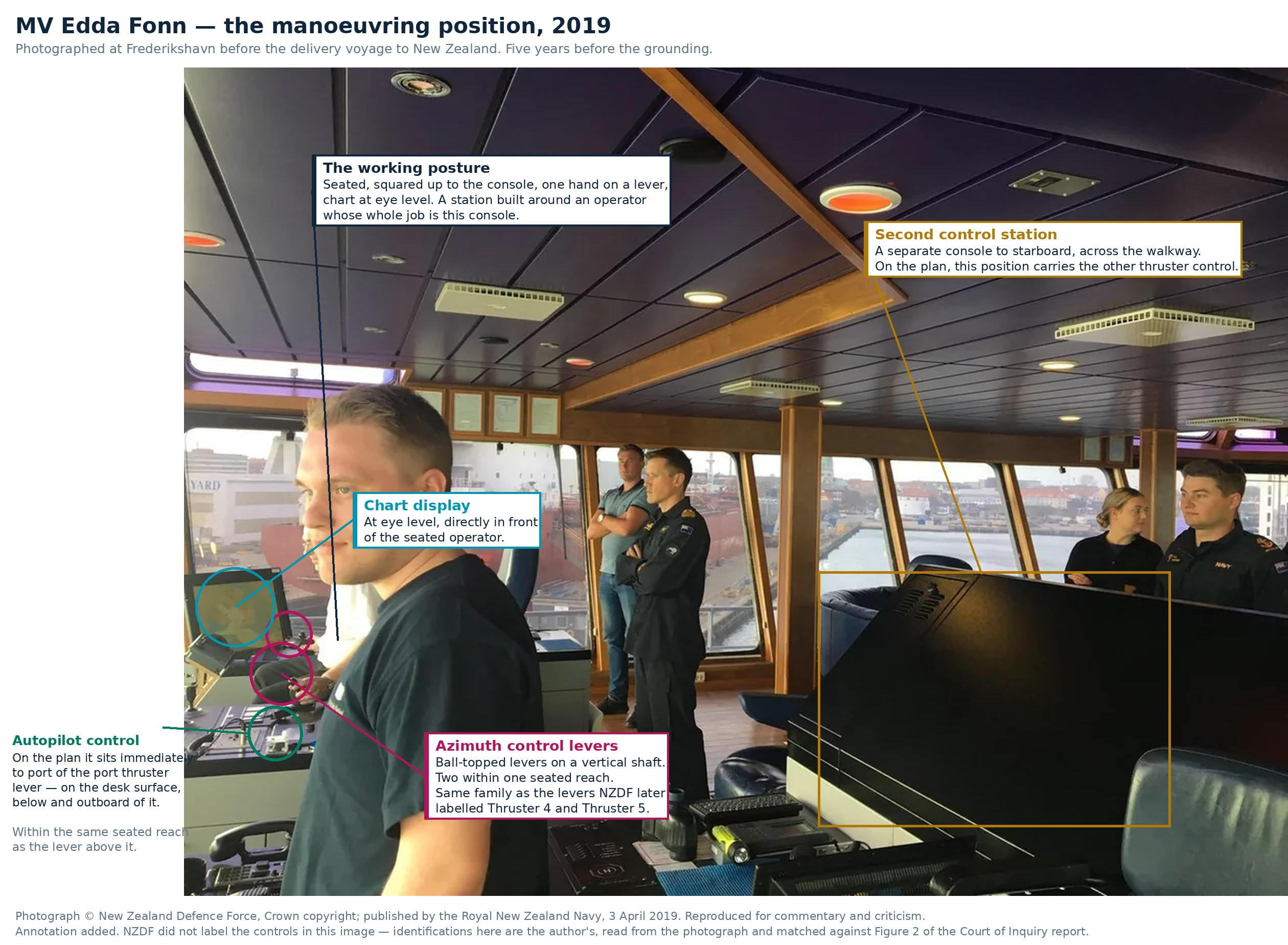
The bridge of MV Edda Fonn at Frederikshavn, Denmark, before her delivery voyage to New Zealand, April 2019. © New Zealand Defence Force, Crown copyright. Published by the Royal New Zealand Navy, 3 April 2019. Reproduced for commentary and criticism. Source.
A note on what I can and cannot say
The photograph is an NZDF file image of the bridge, not a photograph taken on the night. The labels in white boxes are NZDF’s; the coloured annotation is mine. My identification of which console is which is inference, matched against Figure 2 of the report — NZDF labelled the controls, not the consoles.
Figure 2 is described as a diagrammatic layout based on an exhibit. It marks controls, not displays. So nothing here claims what mode indication was or was not visible on those screens. That remains unknown from the public record, and it is the first thing I would want answered.
Three officers face court martial arising from the loss. Nothing above is a comment on those proceedings. The argument is about the bridge, not the people standing at it.
All findings and times from the Court of Inquiry into the loss of HMNZS Manawanui, final report dated 31 March 2025. Paragraph references appear on the figures.
Images and sources
Diagrams and photographs of HMNZS Manawanui are © New Zealand Defence Force, Crown copyright, reproduced here for the purposes of commentary and criticism, with the source cited on each image. No endorsement by the New Zealand Defence Force is implied. Analysis, annotation and any errors are the author’s own.
If you hold rights in any material here and would like it amended or removed, contact contact@yachtprep.com and I will act promptly.
About
YachtPrep Team
YachtPrep Team is a passionate developer and boating enthusiast with years of experience in web development and maritime activities. They love sharing knowledge and helping others navigate the waters of both coding and boating.