HMNZS Manawanui | 04 Checklist
A hundred and twenty-two seconds, and a checklist that starts at item three
Introduction
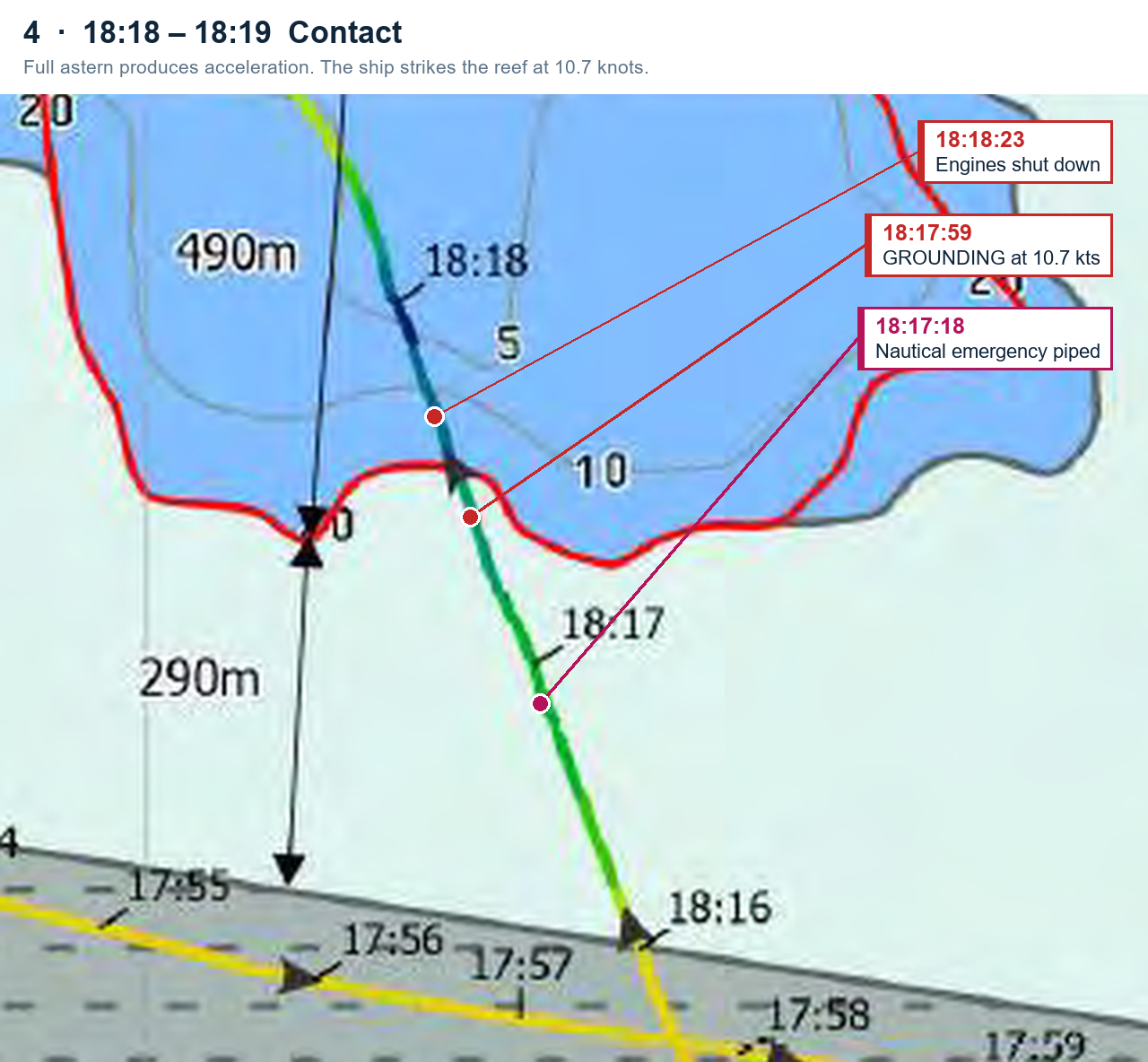
At 18:15:57 the officer of the watch on HMNZS Manawanui said “no steering to starboard”. That is the moment a diagnosis was made: thruster control failure.
At 18:17:59 the ship struck Sinalei Reef at about 10.7 knots.
A hundred and twenty-two seconds between the two. At ten knots that is a little over six hundred metres of sea room. It is not long. But it is not nothing either, and what the crew did inside that window tells you something that the phrase “human error” does not.
What they did with the time
They were not idle and they were not frozen.
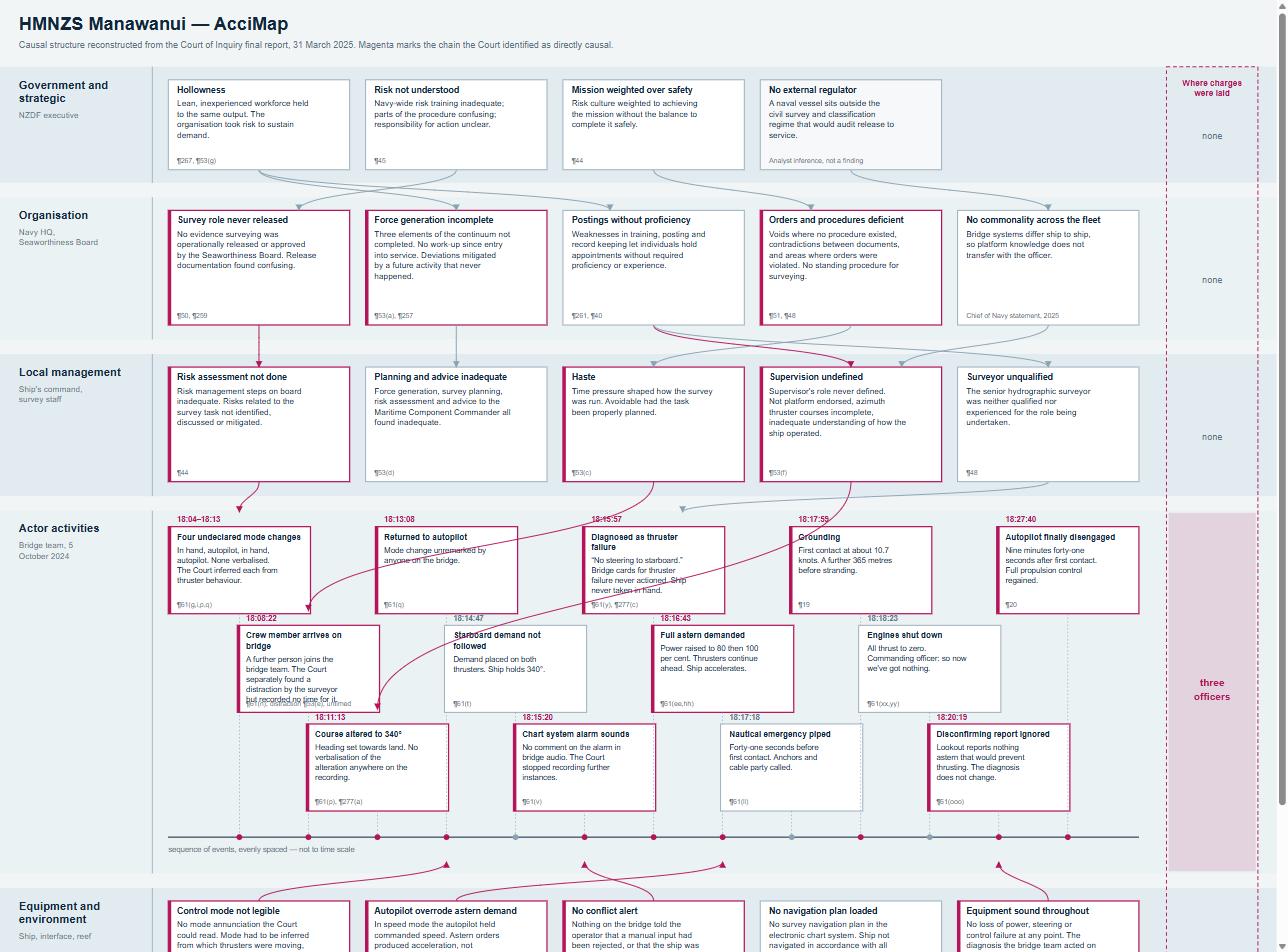
18:16:43 — thrusters ordered astern, power to eighty per cent.
18:17:00 — power to one hundred per cent.
18:17:03 — emergency shutdown called.
18:17:18 — nautical emergency piped. Anchors and cable party called away.
Four decisive actions in thirty-five seconds. That is a bridge team reacting quickly and correctly to what they believed was happening.
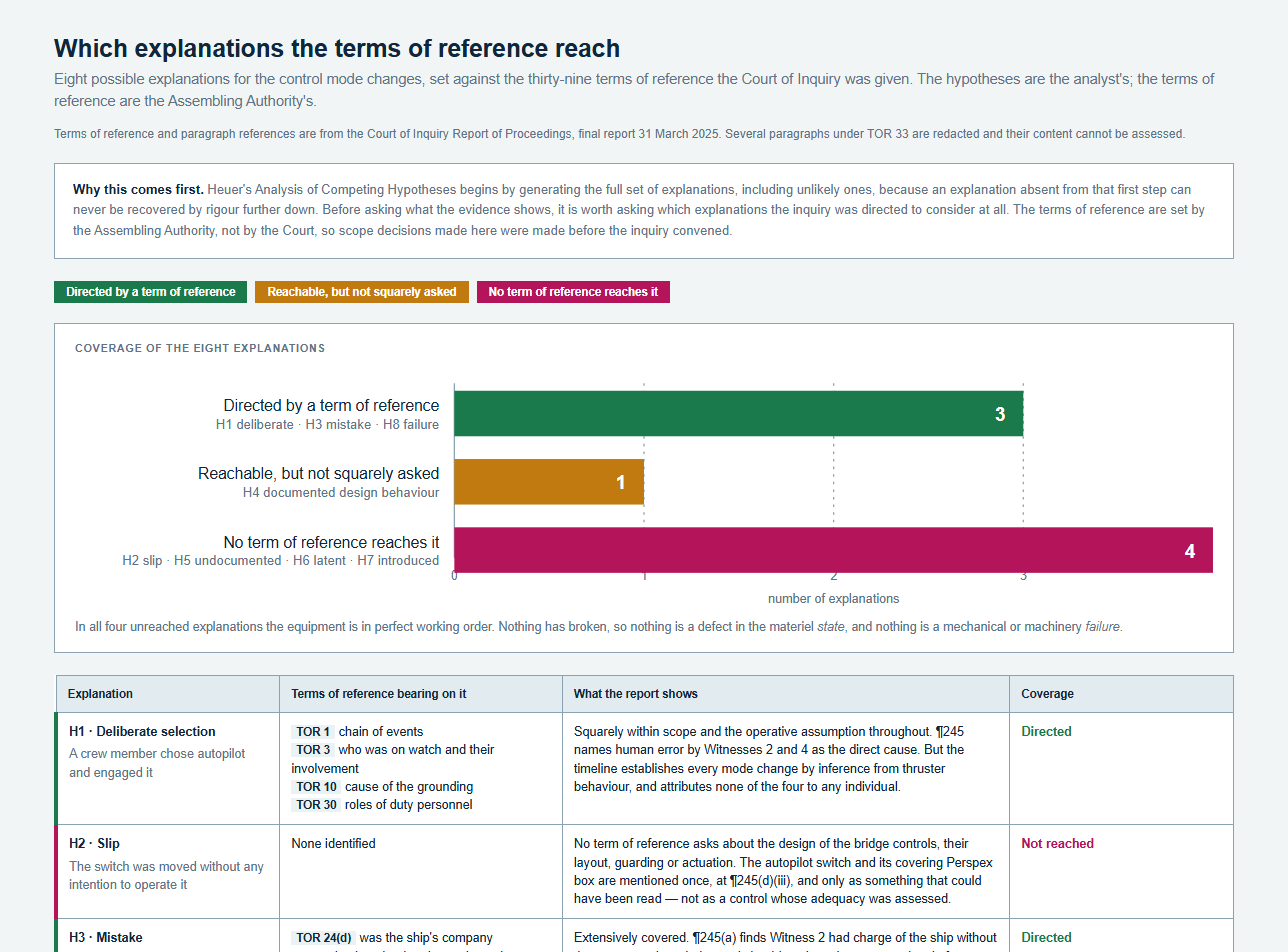
Every one of those actions was nullified by a single fact: the ship was in autopilot, and the autopilot was in speed mode. It was holding a commanded speed and reading the astern demand as a disturbance to overcome. The harder they pulled astern, the more power went ahead. At 18:17:53 the officer of the watch reported ten knots and increasing, under full astern.
One switch would have converted all four of those actions from ineffective to effective. Taking the ship in hand is not a procedure. It is a single control input.
So the usual defence — there was no time — does not hold up. There was time. They spent it.
The procedure that could have worked
The Court of Inquiry is unambiguous about this. It lists the failure to follow the bridge cards for a thruster control failure as a direct cause of the grounding, not as a contributory factor.
The card, in the Court’s own description, required switching the ship from autopilot to in hand — that is, to manual control — and if that failed, taking all thrust off the affected thruster.
The procedure existed. It fitted the situation exactly. It had been trained. It would have worked. It was never actioned.
That is the hard centre of this accident, and no amount of discussion about attention or mode confusion removes it.
Could she have stopped? Distance run from the moment of diagnosis, against three assumptions about how long items (i) and (ii) took before the card reached take the ship in hand.
Author’s own work. A physics model, not measured data: the Court of Inquiry gives no stopping distance for this vessel, and the assumptions are set out on the figure.
But how far down the card was it?
Here is the question I could not answer, and the strange thing I found when I went looking.
If you believe you have a thruster failure, you reach for the card. How long does the card take? Is check your control mode the first item, or the tenth? In a window of a hundred and twenty-two seconds, that is not a detail. It is the difference between a recoverable situation and an unrecoverable one.
Look closely at how the Court sets out what the card required. The enumeration begins at item (iii).
There is no ellipsis. No redaction mark. No note that anything has been removed. The list of what the bridge cards demanded simply starts at the third item.
Two readings are possible. Either items (i) and (ii) have been withheld from the public version, or it is an artefact of drafting. I cannot tell which from the document.
But on either reading, one thing is clear enough. Switching from autopilot to manual was not step one. At least two actions preceded it.
Why that matters more than it looks
I do not know what items (i) and (ii) were. They might be trivial. They might be twenty seconds of confirming indications and identifying which thruster was affected.
What I can say is this. A checklist that reaches establish what mode you are in at item three is a checklist written on the assumption that you already know.
That assumption is reasonable most of the time, and it is exactly the assumption that fails here. Mode is the one piece of state that had gone wrong. It was also the one piece of state that, as the Court records elsewhere, could not be read from the recorded data at all — the inquiry had to infer each mode change from thruster behaviour, using expert testimony.
Aviation resolved this decades ago and resolved it in the opposite order. The reflex drilled into pilots is to strip the automation off first and diagnose afterwards, precisely because the automation is the thing most likely to be misleading you. Disconnect, fly the aircraft, then work out what happened. Not: work out what happened, and somewhere in the middle of that, check whether the autopilot is flying.
Maritime practice largely has no equivalent reflex.
The nine minutes nobody talks about
If you still think a hundred and twenty-two seconds was too short, consider what happened after it ran out.
The ship struck at 18:17:59. She travelled a further 365 metres and came to rest at 18:19:30.
At 18:18:23 the engines were shut down, to defeat the thruster failure. At 18:20:19 a lookout reported aloud that there was nothing astern that would prevent thrusting — direct evidence against the diagnosis, spoken on the bridge, heard.
The autopilot was not disengaged until 18:27:40. Nine minutes and forty-one seconds after first contact. Fourteen and a half minutes after it was engaged.
By then the clock had stopped mattering. The ship was aground. There was no time pressure left, no startle, no urgency of manoeuvre. And still nobody reached for the switch.
Whatever explains that, it is not a shortage of seconds.
Where I come out
Two things are true at once and it is worth holding both.
The procedure was not followed, and that is a direct cause. The Court says so. It is why standard operating procedures exist — to supply the right action at the moment when your own judgement is least reliable. Three officers are before a court martial and the inquiry’s findings on this point are plain. And the procedure was not built to be reached in two minutes. Mode was not item one. Nobody had drilled the automation-off-first reflex. The card was headed thruster control failure, which to a crew already convinced they had a thruster control failure would have looked like something they were already dealing with.The frame did not just cause the misdiagnosis. It made the correct procedure look as though it had already been actioned.
The document I would like to see
None of this is settled. What would settle it is a single page: the thruster control failure bridge card as it stood on 5 October 2024.
It is one sheet. It is not obviously sensitive. It would tell us what items (i) and (ii) were, how long the card takes to work through, and whether mode was ever going to be reached in the time available.
I have asked. If I get it, I will publish what it says.
Note added 20 September 2026. An earlier version of this post said I had asked for the thruster control failure bridge card. That was wrong. I had intended to request it and had not. The original wording is left above.
All times and findings from the Court of Inquiry into the loss of HMNZS Manawanui, final report dated 31 March 2025. Stopping distances and handling characteristics are not given in the report and are not asserted here. This is analysis of the inquiry’s published findings and is not a comment on the court martial proceedings arising from the loss.
About
YachtPrep Team
YachtPrep Team is a passionate developer and boating enthusiast with years of experience in web development and maritime activities. They love sharing knowledge and helping others navigate the waters of both coding and boating.